

THAT PAINTING THAT STAYS WITHIN US: MY ENCOUNTER WITH RENOIR


You don’t need to know art history. You don’t need to be familiar with the biographies of great painters, nor to precisely distinguish between periods, styles, or movements. It is enough that, once, a painting stops you. That it draws you in, holds your gaze—and stays with you.
You look at it for a long time, almost in wonder, asking yourself how the artist managed, with just a few strokes, to tell a story that feels strangely close to you. At first glance it may have nothing to do with you, and yet you remember it. It is etched somewhere inside you. And then it becomes yours—as much as it is the artist’s.
Does that feeling sound familiar? Perhaps a specific painting has already cross your mind.
I could write about many paintings, but today I want to speak about one in particular. One that is special to me.
Painted at the end of the 19th century, more precisely in 1888, by the prominent French painter Pierre-Auguste Renoir, titled “Girl with Flowers”.
Why this painting?


It is not among his most famous works. It is not "Dance at Le Moulin de la Galette", which no one would could deny its magnificence, nor is it as famous as Van Gogh’s "Sunflowers" or Monet’s "Water Lilies". And yet, I remember exactly the moment I first saw it. I thought it was breathtaking—because of its colors, the purity and tenderness of the girl portrayed, the choice and harmony of the palette, the vitality it radiates, and the layered emotions it carries. The one in the painting appears calm and secure, bathed in sunlight, nestled within a sea of greenery and flowers.
I don’t know whether I recognized myself in that girl—some distant, older version of myself, farther away than I would like—or perhaps the image of a child I would wish to have. I only know that I found something of my own in her.
The green that surrounds her is in perfect harmony with the red of her cheeks and the ornaments in her hair. This complementarity makes the painting exceptionally harmonious. Everything feels connected: the forest setting, the light, the central position of the girl—at once slightly sad and slightly happy. The smile is there, but at moments it seems her eyes carry an uncharacteristic seriousness for a child, a hint of melancholy, defiance, curiosity. Conveying that impression is extraordinarily complex for anyone who attempts to translate it onto canvas.
Perhaps that is precisely Renoir’s strength. That quiet reminder that pain passes, but beauty remains, as he himself said. “There are enough unpleasant things in the world—why shouldn’t art be pretty?” was his guiding principle, and I truly feel that, deep down, despite the darkness from which it so often emerges, art ultimately rests on hope and beauty.
Five years ago, I tried to copy this painting as a painting exercise. I was partially satisfied with the result, but recently I felt the need to try again. There were, truthfully, painful moments—inevitable when something matters to you—but also moments of enjoyment. Of immense satisfaction. Even when you don’t fully succeed, entering Renoir’s world of happiness and light is, in itself, a precious experience. Simply trying has value.
I struggled with proportions, with expressing both strength and tenderness where the painting demanded it. I did not aim for a perfect copy, but for conveying mood, atmosphere, and emotion. However it went—I did not give up. And I learned several important lessons, small but valuable, which I would gladly share with other artists, or with anyone who wishes to listen:
Underpainting as a foundation of confidence
Although Renoir painted mostly with oils (sometimes with watercolors or oil pastels), for those of us who need a bit more security and structure—especially experimenters, perfectionists, those who doubt and constantly revise—it can help to create an underpainting in acrylics (which dry much faster than oils and tend to give a firmer base). Later, when uncertainty or mistakes arise, you can always return to that structure without fear that the painting is “lost.” What follows, of course, is the soft, gentle, romantic phase of applying oil paint.
Proportions are solved at the beginning, not at the end
Likeness and credibility are not created in the final details; they are built in the early stages. I often deceive myself into thinking I can fix things later, but that only makes everything harder. If the basic relationships are wrong—the position and angles of the eyes, their spacing, the tilt of the head, the relationship between head and body—no later detail will fully correct them. Spending more time at the beginning ultimately saves time, patience, and leads to greater satisfaction with the final result.
Thinking in large shapes, not details
One of the most common amateur traps is focusing on small details instead of the whole. Professional painting means constructing form through relationships of color, tone, and brushwork. Only when the large shapes work do details begin to make sense. My biggest and most frequent mistake in portraits is the premature desire to paint the eyes—the specific expression—and to linger there, neglecting everything else. It is a temptation I struggle to suppress, even while knowing it is one of the clearest signs of amateurism and a source of making painting harder than it needs to be.
The role of medium—linseed oil as an ally
Moderate but confident use of linseed oil allows colors to move, blend, and achieve that characteristic softness and glow. Overly dry paint suffocates the brushstroke and makes the painting heavy. This image, above all, breathes softness, luminosity, and tenderness, which are not easy to achieve. Control is, of course, essential—but excessive restraint often leads to stiffness.
Variety of brushstrokes as a source of vitality
Changing direction, pressure, and length of strokes is crucial for the rhythm of a painting. Uniform strokes create monotony and a “dead surface.” Renoir’s paintings live precisely because of this playfulness of the brush—there is no mechanical repetition anywhere. This is another thing I constantly remind myself of and work on.
One reference—one truth
Working from multiple reference photographs, even when the subject is the same, can seriously disrupt consistency of light, shadow, and atmosphere. Different light sources introduce confusion. Committing to a single reference, with freedom of interpretation, leads to a clearer and more confident result in the long run—something I learned firsthand after mixing references, which I do not recommend.
A copy is not imitation—it is a dialogue with the original

The goal of copying is not perfection or photographic accuracy. The goal is understanding: how the artist thought, how they built the surface, how they balanced tenderness and strength of the stroke. Bringing something of your own into it is not a mistake—it is a sign that the painting is becoming part of your own visual language. I, of course, left my own trace and impressions as well, such as a small unplanned heart on the right side. (when paint dripped in that spot, I decided to give it an appropriate form).
The psychological lesson: persistence matters more than talent
There are phases when a painting looks bad. Not unfinished—truly bad. This is a normal part of the process. The difference between progress and giving up often comes down to the willingness to patiently pass through that phase, even to step away if necessary, but to return to the painting. The key is simply not to give up.
The painting as a space for learning, not pressure
This is not a painting for sale. It doesn’t have to be perfect. Put something of yourself into it. This is a painting for practice, for understanding, for enjoyment, and for paying tribute to the original. When you free yourself from the pressure of the result, the process becomes more honest—and paradoxically, more successful.
If this text has, even for a moment, reminded you of a painting you carry within yourself, then it has fulfilled its purpose. Perhaps you will want to bring it to life on canvas, and I hope that at least some of these reflections may serve as a guide. Every creative attempt has value and is never wasted time—you will certainly take something from the exercise.
Seek, make mistakes, and try again—because it is precisely there, in that process, that art truly comes into being.
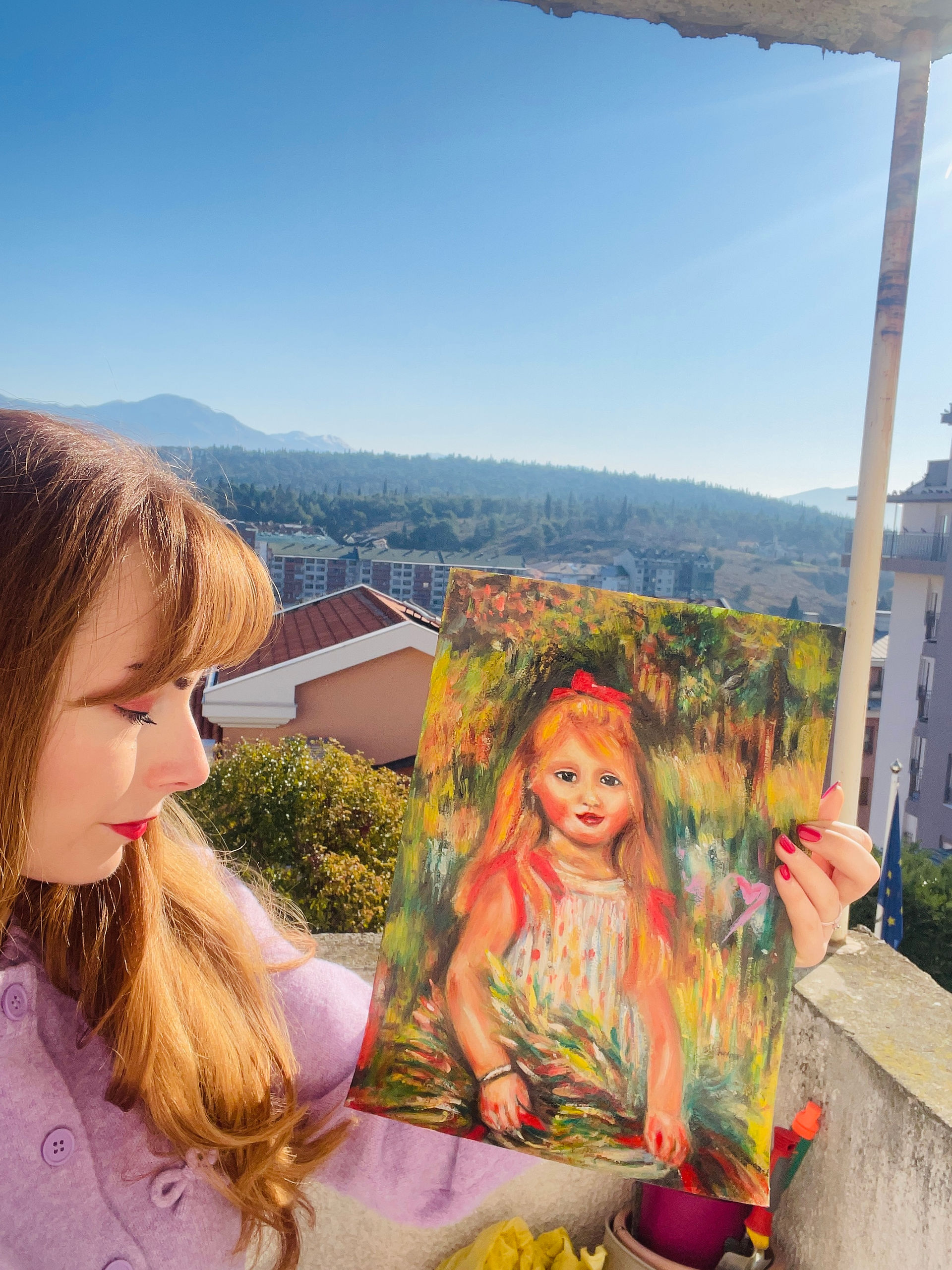


P. S. And of course, I will continue working on it, improving it through mistakes, attempts, and an even greater love and admiration for his beautiful painting and him as its creator.


Comments